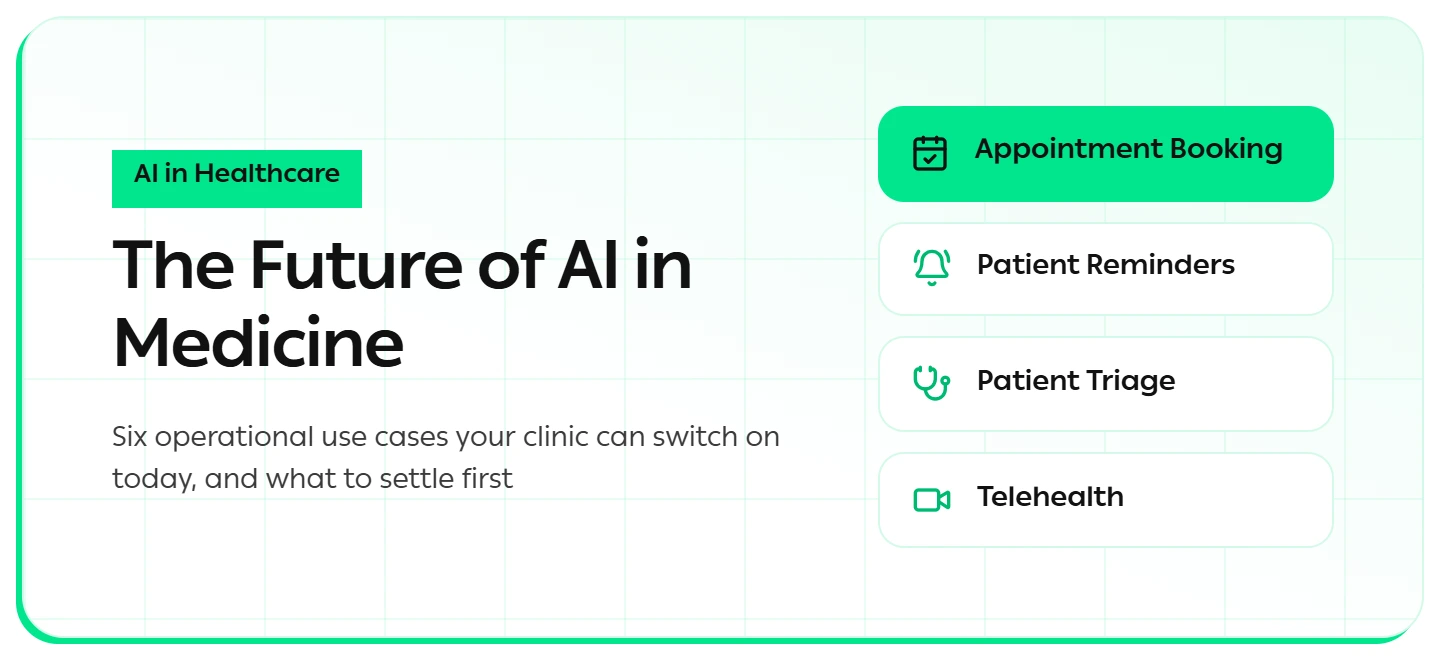
The future of AI in medicine does not start in the radiology room, but with the phone ringing after reception closes. Your clinic loses appointments because nobody answered, and follow-up patients drop off because nobody reminded them. This guide covers six operational use cases you can switch on today, and what to settle first.
What Is AI in Medicine and What Does It Do for Your Clinic?
.webp)
AI in medicine is the use of machine learning and natural language processing to support clinical decisions and automate clinic operations: medical image analysis, case and Patient triage, appointment booking, and patient reminders. The beneficiary is the clinic or medical center, and the outcome is fewer lost appointments and more time with the patient.
The clinical track needs licenses, data, and long validation, while the operational track goes live in days and shows impact in the first month. That is why the future of AI in medicine practically starts with appointments and reminders, not diagnosis.
Hulul works on the operational track: connecting your clinic to patients on WhatsApp, Instagram, and web chat, with support for Arabic and 12 local dialects. Explore AI Automation for Healthcare and the sector's use cases.
6 Use Cases Driving the Future of AI in Medicine
.webp)
The order here runs from fastest to slowest to activate, not from most to least exciting. The first four run on a single channel with no deep technical integration, the fifth needs an internal process, and only the sixth enters regulated clinical territory. Start at the top and measure before moving down, because each use case gives you data that makes the next one more precise.
1. Appointment Booking Without a Receptionist
The patient picks the doctor and time inside the conversation and gets instant confirmation. That frees the phone line and stops booking requests from vanishing after hours.
Most booking requests arrive in the evening and on weekends, outside reception hours. Booking automation turns that window from dead time into selling time, and cuts first response time from hours to seconds.
2. Fewer Cancelled Appointments
A 24-hour reminder with a confirm or reschedule button puts the slot back into circulation instead of leaving it empty. The impact lands directly on clinic occupancy. Run the reminder in two stages:
- A confirmation message at booking that fixes the appointment in the patient's mind.
- A message the day before with a reschedule button instead of a silent no-show.
3. Triaging Cases Before Arrival
Structured questions about symptoms and duration route the patient to the right specialty and escalate urgent cases to emergency. Triage here is administrative routing, not medical diagnosis.
The benefit runs both ways: the patient does not book with the wrong specialty, and the clinic does not spend a doctor's time on a case outside their field. That is what makes the future of AI in medicine a question of flow management before it is one of diagnosis.
4. Follow-Up Reminders
Follow-up patients forget the next visit and the tests they need. A scheduled message on their own channel raises treatment-plan adherence, and matters most in chronic conditions and post-surgical follow-up, where dropping off costs both patient and clinic.
As attendance and cancellation data accumulates, predictive analysis becomes possible: the system flags the patients most likely to drop off so the clinic reaches them first.
5. Telehealth Consultations
Some visits do not need a physical presence. Collecting data and test results before the call makes the consultation shorter and sharper. In practice: a short in-chat form capturing the current complaint, current medication, and the latest test results, so the doctor starts the call with the full picture.
6. Early Diagnosis Support
Medical image analysis and predictive analytics systems flag suspicious areas on scans for the doctor. The decision stays with the physician, and the system is a support layer subject to licensing and clinical validation. This is the longest track, which is why it comes after the operational layer is in place, not before.
What Should You Settle Before Going Live?
Patient data privacy comes first. The practical rule: never request medical details in chat beyond what the appointment requires, keep the electronic medical record within its own system, and set access permissions per staff member.
Second, the limits of liability. State explicitly in the bot's reply that it does not provide diagnosis, and that urgent cases route straight to the emergency number or an available human agent. The same principle is stressed in WHO's guidance on AI ethics in health.
Third, dialect. Patients write in their own colloquial Arabic, so a model that does not understand local dialects fails on the first message. That is the reason to pick a solution trained on Arabic and its dialects rather than a translated global one.
What Do You Switch On First?
The channel comes before the model. The practical order:
- Activate WhatsApp API on your published clinic number — Hulul is a certified Meta partner for the WhatsApp Business API.
- Connect the doctors' schedule so available slots are real, not estimated.
- Turn on appointment and follow-up reminders and track the cancellation rate monthly.
- AI for Instagram: suits aesthetic and dental clinics whose requests come from stories and posts.
Track only two metrics in the first month: cancelled appointment rate and first response time on inquiries. Review Hulul's plans and pick what fits your clinic.
Conclusion
The future of AI in medicine reaches your clinic through operations, not diagnosis: one channel, a connected schedule, and a reminder that runs without you. The clinics that get ahead are not the best equipped, but the ones that started with the simplest step. Hulul is trusted by more than 40,000 brands and institutions across the Middle East.
FAQs About the Future of AI in Medicine
How does the future of AI in medicine change how clinics work?
The future of AI in medicine changes what happens before and after the visit first: faster booking, patient triage, and reminders for follow-ups and tests. Diagnosis support through medical image analysis is an assisting layer for the physician that needs licensing and clinical validation before you rely on it.
What are the most common AI use cases in healthcare?
The most common is appointment management and answering patient inquiries around the clock, because it touches revenue directly and goes live within days. Reminders and remote consultations follow, then clinical applications that need more data and time.
Is clinic automation safe for patient data privacy?
Safety depends on what you collect and where you store it. The practical rule: never request medical details in chat beyond the appointment, keep the electronic medical record within its own system, set access permissions per staff member, and document patient consent to receive messages.
How much does activation cost and when do results show?
Cost follows the number of channels and monthly conversation volume, and a single clinic starts on one plan. Activating WhatsApp, booking, and reminders takes days, and the first measurable indicator is the cancelled-appointment rate after a month of operation.
How do I start in my clinic or medical center?
Start from the AI in healthcare page to see the use cases, then activate WhatsApp automation for booking and reminders, and add Instagram if it is your top request source. Start today with no credit card.