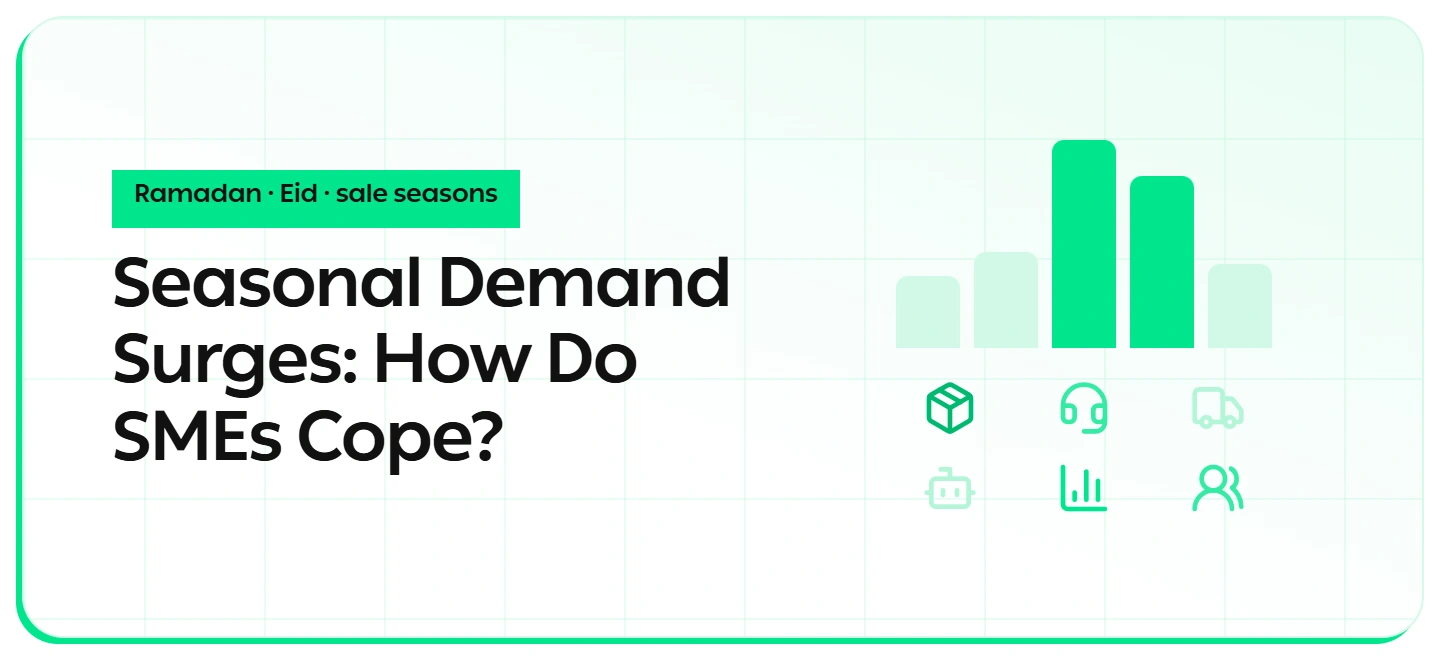
Seasons and holidays, such as Ramadan, Eid Al-Fitr, and Mother's Day, are opportunities For small and medium enterprises to boost sales and increase interaction with the public. However, this boom can become an administrative and logistical challenge due to high demand and competitive congestion. However, how can small and medium enterprises make smart use of these seasons without getting bogged down in operational and marketing challenges? Without drowning in crowded seasons?
The importance of seasons and their impact on consumer behavior
Statistics show that 75% of consumers notice an increase in ads during Ramadan, while 45% prefer to buy products that are promoted through seasonal campaigns. These numbers reflect the strong impact of these periods on purchasing decisions, making advance planning essential.
The most prominent challenges facing projects during the seasons are:
- The sudden rise in demand that leads to issues in inventory management and logistics.
- Huge pressure on customer service teams due to an increase in the number of inquiries and purchases.
- The difficulty of standing out and competing with the heavy advertising campaigns of major brands.
- Difficulty in predicting consumer behavior and seasonal demand fluctuations.
- Managing the marketing budget in a way that ensures the best return on investment.
The sectors most affected by the busy seasons are:
.webp)
- Retail sector: This sector sees a significant increase in sales during the seasons, as demand rises for food products, gifts and clothing.
- E-commerce: With many consumers turning to online shopping, electronic platforms are under great pressure, which requires technical readiness to ensure continuity of performance.
- Logistics: Shipping companies face challenges in fulfilling orders quickly, which may affect customer experience.

Why do small and medium enterprises suffer from crowded seasons?
- Limited resources compared to large institutions: Small and medium enterprises face financial and human constraints that prevent them from expanding rapidly during the seasons.
- Challenges in managing inventory and orders: Managing inventory effectively during busy seasons requires accurate demand forecasts. For example, in the Ramadan 2024 season, I achieved “Basket” platform A 105% increase in sales, which shows the importance of planning ahead to avoid running out of inventory or increasing costs due to inefficient storage.
- Unready staff: As orders increase, small businesses need powerful operating systems such as order management systems (OMS) and automated customer service systems. Additionally, not training teams to deal with peak sales can lead to a poor customer experience that negatively impacts reputation and sales.
3 effective tips to overcome the challenges of busy seasons
- Setting goals and key indicators (KPIs): SMEs should start by setting clear and measurable goals, such as increasing sales by a certain percentage or improving customer interaction on social media platforms.
- Allocate the budget strategically: It is important to distribute the budget to different aspects such as digital advertising, promotions... For example, 45% of consumers are excited to buy products that are promoted through Ramadan campaigns, so it is essential for projects to allocate part of the budget to seasonal campaigns.
- Schedule setting: develop a detailed schedule that includes pre-season, peak season, and post-season stages. This includes understanding the market, designing campaigns, coordinating efforts with influencers, launching campaigns, monitoring performance, and analyzing results.
By understanding these challenges and following effective strategies, SMEs can successfully deal with busy seasons and achieve their marketing and financial goals
How do you prepare for a busy season? (the four steps)
Step 1: Analyzing previous seasons: learning from data to improve performance
The first step in proactive planning is to understand the performance of the previous season. Historical data can be used to identify expected peak periods, study sales performance, and analyze inventory management. For example, if there was a 30% increase in orders during the last week of Ramadan last year, you should be ready for that increase this year.
Using data to:
- Identify periods in which demand rises significantly.
- Most in-demand products and busiest periods.
- Discover the behavioral patterns of customers.
- Review inventory depletion rates during previous seasons to identify products that need to enhance their quantities.
41% of supply chain professionals consider data analysis a priority to ensure that there is no shortage or unnecessary surplus.
Step 2: Develop an integrated operational plan: efficient inventory management and marketing
Supply chain optimization and inventory management
- Ensure reliable suppliers and open communication channels with additional suppliers to avoid any delays in supply.
- Use data analysis tools to determine the required quantities of each product and avoid running out of inventory or excessive storage.
40% of consumers accept to wait two days for express delivery, but the percentage drops by half when the period is increased to 3-4 days, so it is necessary to plan fast and effective delivery.
Step 3: Team Development: Ensure that employees are ready to deal with stress
During the seasons, the number of inquiries and purchases is increasing, requiring your team to prepare for this pressure. Here are some suggested solutions to overcome this crisis:
- Automate some processes such as instant responses to frequently asked questions via chatbots.
- Employ temporary staff to support core work teams.
- Provide intensive workshops for new and temporary employees to ensure they are ready to deal with inquiries efficiently.
- Training teams in stress management skills and dealing with angry customers to maintain customer satisfaction even at peak times.
- Provide incentives and rewards to employees who achieve exceptional performance during the season.
Step 4: Preparing customer support strategies: improving the customer experience during the seasons
Customer service is a crucial element during busy seasons. You should be ready to deal with increased inquiries and complaints.
- WhatsApp bots can be used to provide immediate support, send order updates, and interact with customers around the clock.
- Preparing ready responses to respond quickly to the most frequently asked questions.
- Send reminder emails about offers and discounts before the season starts.
- Offer exclusive offers to distinguished customers to maintain their loyalty.
.webp)
How does “Solutions” contribute to managing seasons smartly?
Adopting technology and automating operational processes helps reduce errors, improve work efficiency, and provide a smooth customer experience. “Solutions” provides smart technologies to help companies manage busy seasons efficiently.
Order Management Systems: Track and Manage Orders Effectively
“Solutions” offers systems Smart order management (OMS) Which allows companies to:
- track orders from the moment of purchase to delivery, reducing operational errors.
- Manage inventory automatically to avoid running out of products or unnecessary inventory increases.
- Generate real-time reports that help analyze sales performance and predict future orders.
- Integration with different sales channels (e-stores, physical stores, and apps) to provide a unified shopping experience.
Process automation: accelerate performance and improve customer experience
Smart chatbots (Chatbots)
During the seasons, it can be difficult for customer service teams to deal with the overwhelming number of inquiries. Here, smart chatbots come from “Solutions” to provide automated support around the clock via WhatsApp and other channels. These robots help to:
- Instant response to frequently asked questions such as delivery times, prices, and offer details.
- Automatically transfer conversations to human agents when needed.
- Collect and analyze customer data to understand their needs and provide personalized recommendations.
Automate email and WhatsApp marketing
The “Solutions” platform offers advanced automation tools that help companies send targeted marketing campaigns via email and WhatsApp.
- Send personalized offers based on customer behavior and interests.
- Schedule and send promotional messages automatically during peak periods.
- Retargeting interested customers through reminders of abandoned carts and exclusive offers.
Integration with payment and shipping platforms: improving the speed of transactions and delivery
solutions Integrated electronic payment; Where solutions support:
- Integration with different electronic payment gateways to provide multiple options (credit cards, Apple Pay, STC Pay, etc.).
- Analyzing financial transaction data to monitor performance and identify the best payment methods for target customers.
Conclusion: Prepare smartly and make the most of the seasons!
In a world of increasing competition, the success of small and medium enterprises during the seasons depends on strategic planning, data analysis, and process automation to ensure that high demand is absorbed without affecting quality or customer experience.
Early preparation is the key to success! Companies that start planning ahead of the season, adopt modern technology tools, and invest in customer experience will be the most able to grow and stand out from their competitors.
FAQ's about Seasonal congestion:
Q1: Why do small and medium enterprises struggle more than large businesses during peak seasons?
SMEs face three compounding disadvantages during busy seasons. First, limited financial and human resources prevent them from scaling up quickly in response to sudden demand spikes. Second, without accurate demand forecasting tools, inventory management becomes reactive rather than proactive — leading to either stockouts or costly overstocking. Third, customer service teams are often underprepared for the sharp increase in inquiries, which damages the customer experience at exactly the moment it matters most. Large enterprises have dedicated infrastructure for these scenarios; SMEs need smart automation and early planning to compensate.
Q2: What are the most effective steps SMEs should take before a busy season begins?
Preparation should follow four sequential steps. Start by analyzing data from previous seasons to identify peak periods, best-selling products, and customer behavioral patterns — historical data removes guesswork from your planning. Then develop an integrated operational plan that secures reliable suppliers, optimizes inventory levels based on demand forecasts, and prepares fast delivery options, since 40% of consumers accept a two-day wait for express delivery but that acceptance drops by half at three to four days. Next, prepare your team through automation of repetitive tasks, temporary staffing, and intensive training. Finally, build a customer support strategy using chatbots, pre-written responses, and pre-season email campaigns.
Q3: How can automation help SMEs manage the surge in customer inquiries during peak seasons?
AI-powered chatbots handle the volume problem by responding to common inquiries instantly around the clock — covering questions about delivery times, prices, offer details, and order status — without requiring human intervention for every conversation. This reduces the pressure on customer service teams dramatically, allowing them to focus only on complex cases that genuinely require a human response. Automated WhatsApp and email campaigns also allow businesses to proactively send order updates, promotional reminders, and cart abandonment follow-ups at scale, maintaining consistent communication with thousands of customers simultaneously without additional staffing.
Q4: How should SMEs allocate their marketing budget during competitive seasonal periods?
Budget allocation should be driven by data from previous seasons and structured across three phases. In the pre-season phase, invest in awareness campaigns and influencer coordination to build anticipation before major competitors dominate the space. During peak season, concentrate spending on conversion-focused channels — targeted digital ads, personalized WhatsApp offers, and retargeting campaigns for cart abandoners. In the post-season phase, shift budget toward loyalty and retention campaigns to convert seasonal buyers into repeat customers. Statistics show that 45% of consumers are specifically motivated to purchase by Ramadan-themed campaigns, confirming that seasonal messaging itself drives meaningful commercial impact when backed by the right budget.
Q5: What role does order management technology play in helping businesses handle seasonal demand?
Smart order management systems (OMS) are the operational backbone of a well-run seasonal campaign. They track every order from purchase through delivery in real time, reducing the manual errors that spike when volume increases suddenly. They manage inventory automatically to prevent both stockouts and unnecessary surplus accumulation. They generate live performance reports that allow managers to make fast, data-driven decisions during the season rather than after it ends. And they integrate across all sales channels — online stores, physical locations, and apps — to provide a unified, consistent shopping experience regardless of where the customer chooses to buy.