Super AI is a term that appears in almost every headline and is rarely understood. A business owner reads about a system that will surpass humans, looks at the tool they actually use, and finds no connection. This article separates the three stages in practical terms, defines what is available to your business today and what remains hypothetical, and how to read the news without being misled.
What Exactly Is Super AI?
.webp)
Super AI (artificial superintelligence) is a hypothetical stage in which a system surpasses human capability across every cognitive task, not in a single task. What exists today is narrow AI: models that excel within a defined scope such as translation or customer service. Who does the difference matter to? Business owners evaluating a technology investment right now.
And the difference is not academic: according to Stanford's AI Index report, the share of organizations using AI in at least one business function rose to 78% in 2024 from 55% in 2023, while generative AI use jumped from 33% to 71%. All of that adoption happened inside the first stage alone.
The Three Stages: From Narrow to Super
.webp)
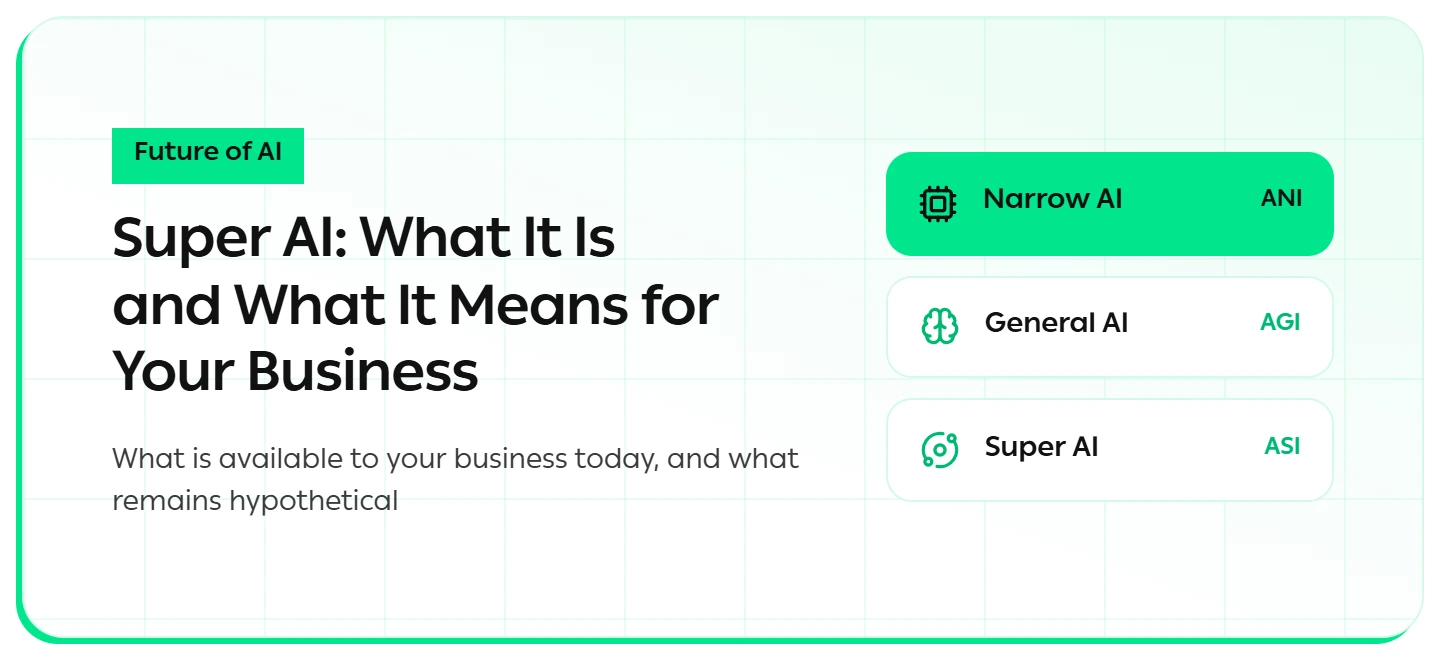
The three stages differ in the scope of capability, not in model size:
- Narrow AI (ANI): excels at a defined task and fails outside it — available and commercially used today.
- General AI (AGI): transfers learning across domains the way humans do — under research, with no agreed timeline.
- Super AI (ASI): surpasses humans across every cognitive task — hypothetical and unrealized.
Confusing the stages is what makes some companies wait for technology that does not exist while competitors use what already does. The large language models you see today belong to the first stage, not the third, however impressive their output looks.
Why Does Narrow AI Look Stronger Than It Is?
Generative models write, summarize, and translate at high quality, so they appear to understand. In reality they predict the next word based on patterns learned through deep learning and natural language processing, which makes them excellent inside their scope and unreliable outside it.
A practical example: an online store connected a model to its product database and it began answering sizing and shipping questions accurately. When a customer asked about a tax policy that was never in the source, it produced an answer that read well and was factually wrong. The limit here is not the model's intelligence but the boundary of what it was given.
Therefore the rule for a business owner: any output touching a financial, legal, or medical decision needs human review. Automation takes the repetitive volume; the human takes the exception and the decision.
What Risks Do Researchers Actually Discuss?
The serious debate around super AI concerns aligning models with human goals, the ability to verify their decisions, and the concentration of computing power in few hands. Because the stage is hypothetical, timeline estimates vary widely among researchers and no agreed figures exist.
By contrast, the AI risks you face today are entirely different: inaccurate output, data leakage, and no human review on sensitive decisions. AI governance starts here, not in the distant future. The minimum worth applying in any small company:
- Define which tasks the model may complete on its own.
- Define what needs human approval before it is sent.
- Log sensitive conversations for periodic review.
- Never put full customer data into tools whose storage location you do not know.
How Do You Read AI News Without Being Misled?
Three questions are enough for any headline: what task was completed exactly? Who measured the result and against what benchmark? And does the model work outside its training data or only inside it? A story that does not answer these is marketing, not a research result.
And when you read about a new capability, ask about cost too. A model that delivers an impressive result at a high running cost does not suit a small business, and the right measure is return per conversation or per order, not output quality alone.
What Is Available to Your Business Today?
What lifts your sales this quarter is not super AI, but ready machine learning applications:
- A chatbot that answers customer inquiries instantly and escalates the complex ones.
- AI Solutions for Marketing that runs follow-up and abandoned-cart campaigns automatically.
- AI for Twitter that catches public complaints and answers before they escalate.
- Analytics dashboards that reveal which product and which channel deliver the real return.
AI Agents: The Next Available Step
AI agents are the next practically available step: models that execute a chain of steps rather than a single reply, such as taking the order, checking stock, and issuing the payment link inside the same conversation. This is not super AI, but it is the most you can run today with measurable return.
AI solutions deliver this layer in Modern Standard Arabic and 12 local dialects, trusted by more than 40,000 brands and institutions across the Middle East. Review the plans and pick what fits your size.
Conclusion
Super AI is a hypothetical stage that has not arrived, and the only stage you can make a decision about today is the first. So the practical takeaway is simple: do not wait for a wave that has not landed, start with one repetitive task whose return you measure within a month, and set the limits of human review from day one. The business building its data and processes now will be readier for any coming stage than the one that waited.

FAQs About Super AI
When do researchers expect super AI to arrive?
There is no agreed date. Researcher estimates range from a few decades to rejecting the idea entirely, because super AI is a hypothetical stage that has not been built and there are no agreed benchmarks for judging how close it is. Any headline naming a definitive date is an opinion, not a research finding.
What is the difference between super AI and general AI?
General AI means transferring learning across domains at human level, while super AI exceeds that level by a wide margin. Neither stage has been realized, and confusing them with the large language models available today is the most common error in media coverage.
What are the risks of superintelligence for jobs and business?
The observed effect so far is a change in the mix of tasks within a job rather than the elimination of the job: repetitive tasks get automated and the employee moves to complex cases and decisions. Scenarios of wholesale elimination are tied to a stage that does not yet exist.
Is Super AI the Same as What We Use Today?
Today’s AI can perform specific tasks or handle a broad range of tasks, but it does not have comprehensive superiority over human capabilities. Super AI, on the other hand, refers to a hypothetical system that surpasses the best human capabilities across a wide range of cognitive domains.
How Could Super AI Change the Way Businesses Operate?
If Super AI becomes a reality, it could change how businesses approach tasks that currently require complex analysis or decision-making. Its potential impact could extend to areas such as research, product development, data analysis, and customer service, although how these capabilities would actually be applied and affect businesses remains uncertain.