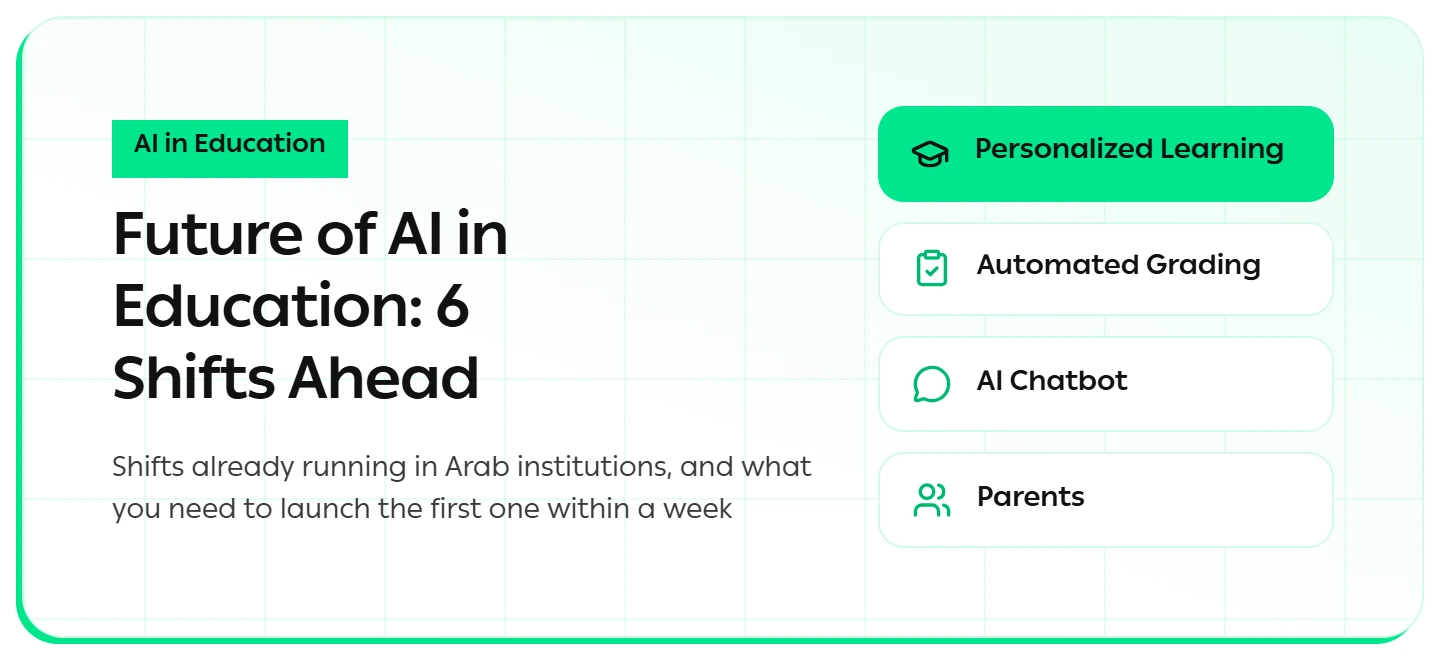
The future of AI in education is no longer a question for later: the admissions desk is drowning in enrollment calls, teachers spend their evenings grading near-identical papers, and parents wait for a reply that never arrives. This guide covers six shifts already running in Arab institutions, and what you need to launch the first one within a week.
What Is AI in Education and How Does It Work?
.webp)
AI in education is the use of machine learning and natural language processing to automate learning and administrative tasks: personalizing each student's path, grading assignments, and answering student and parent inquiries. The beneficiary is the school or institute, and the outcome is less time on repetitive admin work and a faster response time on every inquiry.
The difference between a system that serves a school and one that annoys it is user intent understanding: telling apart a parent asking about an exam date and one disputing a grade. That is where the generative AI layer comes in, phrasing a reply in the school's own voice instead of a rigid button menu.
Hulul works on exactly this operational layer: connecting the school to students and parents over WhatsApp, Messenger, and web chat, with support for Arabic and 12 local dialects, as a certified Meta partner for the WhatsApp Business API. Explore AI solutions for education.
Six Shifts Shaping the Future of AI in Education
.webp)
The six shifts below are running today in Arab schools and institutes, and none requires an in-house technical team. What they share is that each starts from a single repetitive task, then expands once it proves a number to management. Read them in your own order of priority, not the page's. What unites the future of AI in education in every case is that automation comes before smart learning, because its results land faster and meet less internal resistance.
1. Personalized Learning for Every Student
Systems read student performance in each unit, then automatically suggest harder or easier exercises. The teacher sees who is falling behind before the exam, not after, which is the core of predictive analysis built on academic performance analytics.
Rollout starts small: one subject, one cohort. After a month you compare its results against a cohort that did not use the personalized path, giving you a number to stand on before expanding.
2. Automated Grading
Objective questions are graded instantly, and short essays get a preliminary score the teacher reviews. The gain is not the grade, but the grading hours that go back into teaching: a teacher with 120 students marking two assignments a week spends hours on work with no instructional value.
- Start with objective questions only in the first month.
- Leave long-form essays to full human review.
- Audit a 10% sample weekly to confirm accuracy.
3. A Chatbot That Answers Students and Parents
Questions about schedules and fees repeat hundreds of times a day. AI chatbot trained on your school's policy answers instantly and escalates complex cases to a human agent with the full conversation context.
The impact shows in two seasons: the start of the year and results week. Inquiry volume doubles while headcount stays flat, and that is where the future of AI in education becomes an operational decision rather than a luxury.
4. Enrollment Management and Learning Management System
Enrollment season puts the heaviest load on the admissions desk. Automating document collection and appointment confirmations raises application completion rates. More importantly, an incomplete application is not left hanging: the system reminds the parent about the missing document after two days, cutting the number of applications that stall midway.
5. Reaching Parents on Their Own Channels
Parents do not open a web portal, but they read a WhatsApp message immediately. Absence reports and assignment reminders travel through the channel they actually use, turning the relationship from a phone call after a problem into an early warning.
6. Data-Driven Administrative Decisions
E-learning platforms produce data nobody reads. Connecting them to a single dashboard reveals which subject drives dropout. Four indicators deserve monthly tracking:
- Attendance rate per cohort and subject.
- On-time assignment completion rate.
- First response time on parent inquiries.
- Share of students at risk of failing in each subject.
What Challenges Should You Plan For?
The biggest obstacle is not technology but data quality: a school keeping attendance on paper will not get accurate analysis. Unifying sources is a first step, not a later one.
The second challenge is teacher buy-in. What works is presenting the tool as removing tasks, not monitoring performance, and involving one teacher in the first pilot so colleagues have a peer to ask.
The third is student data privacy, which UNESCO's guidance on AI in education stresses. Collect only what the step requires, set access permissions per staff member, and document parental consent to receive messages.
How Can Your School Start Within a Week?
A school does not need a full digital transformation project to start using AI. You can begin with one focused step, such as automating responses to the questions parents ask most frequently.
Start by reviewing the most common inquiries received by the front desk, then build a knowledge base covering the information parents regularly need, such as tuition fees, school schedules, admission procedures, and school activities. Next, choose the channel parents use most, such as ai for Messenger, and activate the bot there.
Once the bot is live, monitor response times and the types of inquiries it handles, then use these insights to gradually improve the experience. This approach allows the school to get started quickly and expand automation based on its actual needs.
Institutions that start in this order see a measurable result before the first month ends. Review Hulul's plans and pick what fits your size.
Conclusion
AI in education is not only about automating responses. It can help schools create a more organized communication experience for parents, from questions about tuition fees and admissions to everyday inquiries. As the volume of communication grows, providing fast, accurate, and timely answers becomes an important part of the overall school experience.
If your school is looking for a practical way to improve communication with parents while reducing the pressure on reception and customer service teams,Hulul Company can help you build an AI-powered communication experience. Its solutions are already used by more than 40,000 brands and organizations across the Middle East.
FAQs About the Future of AI in Education
What is the future of AI in education in the coming years?
The future of AI in education points to operational automation before learning itself: instant replies to students and parents, automated grading, and personalized study paths built on each student's performance. The teacher stays at the center, while technology takes the repetitive tasks that consume time without adding instructional value.
How is AI actually used in schools?
The most common use is answering recurring questions about fees, schedules, and results, followed by enrollment automation and appointment reminders. The instructional layer comes next: automated grading and personalized exercises. Starting from operations shows results faster and meets less internal resistance.
Do AI education tools require a technical team?
No. No-code platforms use a drag-and-drop interface and train the model directly on school files without writing code. An administrative staff member can run it and update its replies, and the technical role is usually limited to connecting your existing student system if you want data sync.
How Can AI Help Schools Improve Communication with Parents?
AI can handle parents’ frequently asked questions and provide instant answers about tuition fees, school schedules, admissions, and activities, while routing cases that require human assistance to the appropriate staff member. This reduces the pressure on reception teams and makes communication with the school easier and more organized.
What Is the First AI Use Case That Can Benefit Your Educational Institution?
Explore AI solutions for education to discover use cases relevant to schools and educational institutions, then build a chatbot to handle the most common inquiries and activate it on the channel parents actually use. You can try the solution free for 14 days with no credit card required.