Most AI projects fail not because the technology is weak, but because the chosen algorithm never fit the problem. Knowing AI algorithms and their differences turns you from a buyer relying on vendor promises into a decision-maker asking the right questions.
What Are AI Algorithms?
.webp)
AI algorithms are sets of mathematical rules that analyze data to detect patterns and make decisions or predictions without explicit programming for each case. The algorithm determines how a model learns; the data determines what it learns.
The difference is not theoretical. An insurer predicting fraudulent claims picked a deep neural network, hit high accuracy, then could not explain any decision to its regulator, and the project stopped despite working technically.
Successful projects start by asking: what output do we need? Not: what is the newest technology?
Classifying AI Algorithms by Learning Method
The most useful classification of AI algorithms rests on the data you hold and the result you need, not on how well known it is. Three families cover nearly everything enterprises require.
This matters commercially. According to the AI Index Report from Stanford University for 2026, 88% of enterprises use AI, yet gains concentrate in a small group that matched the problem to the right tool.
.webp)
Supervised Learning
The algorithm is fed pre-labeled data containing both question and answer, and learns the relationship between them. A concrete example: give the model ten thousand past orders with each outcome, and it works out which attributes correlate with cancellation and which are noise.
This suits predicting a numeric value such as sales volume, or classifying an item as “customer likely to churn.” It is the first choice wherever you hold a clear historical record of outcomes.
Unsupervised and Reinforcement Learning
In unsupervised learning there are no ready answers. The algorithm discovers hidden groupings inside the data itself, ideal for splitting your customer base into behavioral segments or flagging anomalous transactions.
Reinforcement learning, by contrast, learns through trial and error with rewards and penalties. It powers dynamic pricing and inventory, and is hardest to run because it needs a safe simulation environment first.

Six Common Algorithms in Business
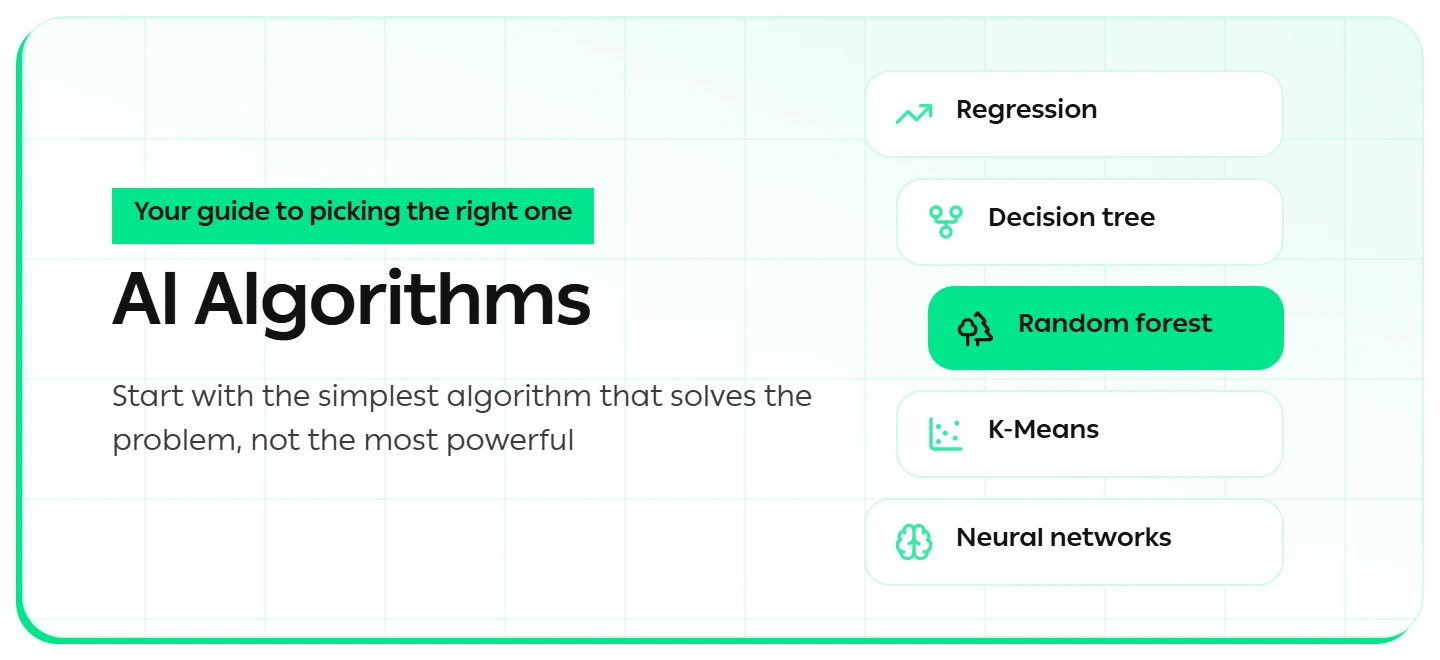
These families cover most machine learning algorithms projects in enterprises:
- Linear and logistic regression — simplest and fastest, excellent for predictive models
- Decision tree — splits data into logical branches, preferred when justifying a decision is mandatory
- Random forest — combines hundreds of trees, the default for prediction projects
- K-Means clustering — divides data into similar groups, common in customer segmentation
- Neural networks — layers trained through backpropagation, the basis of deep learning
- Transformer models — a modern architecture handling text, the engine behind language models
How Do You Choose the Right Algorithm?
Choosing among AI algorithms rests on four factors settled before any project: output type required, size and quality of your data, explainability demands from regulators, and monthly running cost.
Regulated sectors such as banking need a model that justifies its decision, favoring the decision tree over deep networks even when the latter is slightly more accurate.
The golden rule: start with the simplest algorithm that solves the problem. A regression model running today beats a neural network needing six months and data you lack.
Sector Applications
The required output determines the algorithm family per sector:
- AI solutions for banking — classification for fraud detection and predictive models for credit scoring
- AI for data analysis — clustering to surface patterns, regression to forecast demand
- AI solutions for marketing — recommendation and segmentation to set message and timing
- Artificial Intelligence in the Banking Sector — Classification algorithms for real-time fraud detection, and predictive models for assessing creditworthiness.
- AI-Powered Data Analysis — Clustering algorithms to identify patterns, and regression algorithms to forecast demand.
- Marketing Automation — Recommendation and segmentation algorithms to determine the right message and timing for each customer segment.
- Healthcare — Classification algorithms and medical image analysis to help detect diseases, and predictive models to estimate patient risk.
- Retail and E-commerce — Recommendation algorithms to personalize product offerings, and forecasting models to estimate demand and manage inventory.
- Transportation and Logistics — Optimization algorithms for route planning, and predictive models to estimate arrival times and demand volume.
This is why applying one model across every department fails: banking needs auditable classification, marketing needs probability ranking.
How to Start in Four Steps
Turning the above into an execution plan starts with four ordered steps:
- Write the required output in one sentence: a number, a category, or a similar group?
- Count the clean records you hold, since that determines whether neural networks are viable
- Ask whether every decision must be justified to a regulator — a yes rules out uninterpretable models
- Train the simplest candidate first and compare it against a baseline before any upgrade
Conclusion
AI algorithms are not a menu where you pick the newest item, they are tools each with a range it excels at and one where it fails. Define the output first, assess your data honestly, choose the simplest algorithm that reaches the goal, and measure against a baseline within a month. Choosing an algorithm is a business decision made alongside an AI company that understands your sector.
.webp)
FAQs About AI Algorithms
1. What is the difference between AI algorithms and machine learning algorithms?
Machine learning algorithms are a subset distinguished by their ability to learn from data and improve automatically. The broader term also covers rule-based, search, and logic algorithms that execute fixed instructions without any learning at all.
2. How much do different algorithms cost to run monthly?
The gap is large and usually overlooked in planning. A regression model or decision tree runs on a standard server for tens of dollars a month, while a deep neural network requires GPUs that can push the bill into thousands for the same request volume.
3. Do I need a data science team to choose an algorithm?
Not necessarily. Managed platforms select the algorithm and tune its parameters automatically based on your data and objective. Your team’s role centers on defining the problem precisely, ensuring data quality, and interpreting results in business rather than technical terms.
4. What do I do if an algorithm is accurate but its decisions cannot be explained?
Use it as a filtering layer rather than the final decision-maker: it ranks cases by priority and a person decides. Or choose a simpler interpretable model and accept a small accuracy gap in exchange for being able to justify every decision to your regulator.
5. How often should the chosen algorithm be reviewed?
Review performance monthly and run a full reassessment every three to six months. Customer behavior shifts, and the algorithm that was best a year ago may now trail a simpler, cheaper option that has since appeared, or a model improved by your accumulated data.