AI in finance is no longer the preserve of large banks: fintech companies and mid-sized lenders run it today in customer service and application follow-up. But finance is the fastest-adopting sector and the most scrutinized at once, so any use case that cannot be explained to internal audit is not fit to run. This guide covers six use cases and what each one requires.
How Is AI Used in Finance?
.webp)
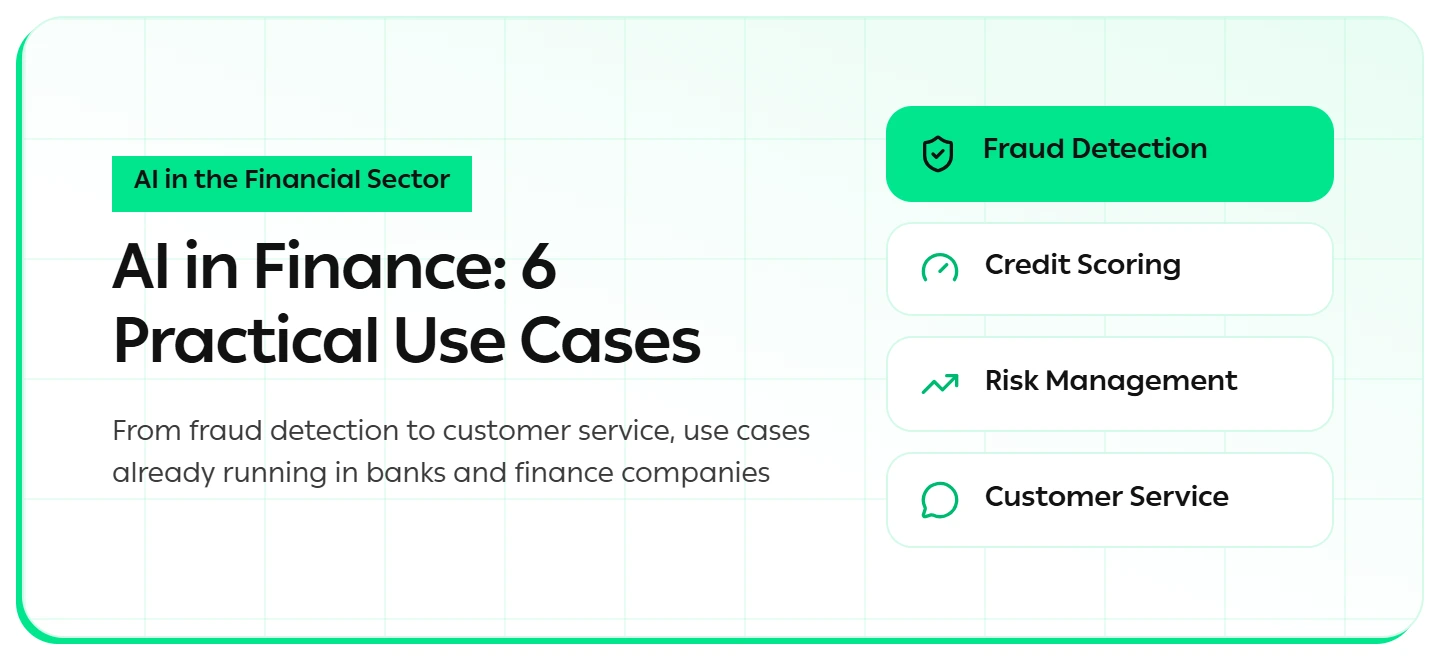
AI in finance is the use of machine learning and natural language processing across four areas: fraud detection, credit scoring, customer service, and risk management. The beneficiary is the bank or lender, and the outcome is faster decisions and fewer files needing manual review.
The scrutiny has a reason: the IMF's Global Financial Stability Report notes that AI-driven trading makes markets faster and more efficient, but may raise volatility in times of stress. So the safe entry point for mid-sized institutions is the customer layer, not the market layer.
Hulul's AI platform covers the customer layer: managing conversations on WhatsApp and web chat in Modern Standard Arabic and 12 dialects, with named payment gateway integrations — Fawry, InstaPay, Mada, Tabby, STC Pay, PayPal. The sector has its own page: AI solutions for financial services.
Six Use Cases Running in the Financial Sector
.webp)
The six use cases below are not equally ready. The first two need historical data, a risk team, and a full validation cycle, while the other four go live within weeks on the conversation layer. So the practical order for any mid-sized institution is to start with the third and fourth, measure the return, then move to risk models built on data the operation itself has accumulated.
1. Transaction Fraud Detection
Anomaly detection models read the customer's normal behavior and escalate transactions outside that pattern for human review within seconds, not days.
What matters most here is tuning model sensitivity: too strict blocks legitimate transactions and angers customers, too loose lets questionable ones through. The metric measured monthly is the false-alarm rate against genuinely detected cases.
2. Credit Scoring for the Underserved
Predictive analysis uses alternative indicators such as payment history and digital transactions to assess applicants without a long banking history.
This is the biggest growth opportunity in the Arab market: a wide segment of small business owners has no traditional credit file, so they are rejected not for weak capacity but for absent data. A practical example: a microfinance company assessed a retail seller with no bank account using 14 months of digital wallet payments and consistent bill settlement, and approved financing that had been denied on paper before.
3. Round-the-Clock Customer Service
Repeat inquiries about balances, installments, and documents make up most of the volume. Automated replies resolve them, with ticket classification by request type and escalation of sensitive cases to an agent with the full context.
This is therefore the fastest AI in finance application to show return, because it lowers contact-center cost and raises customer satisfaction without adding headcount.

4. Financing Application Follow-Up
The longest stage in the customer journey is waiting for the decision. Automatic updates on application status and missing documents cut calls and raise completion rates. Applications that stall midway usually do not fail because of rejection, but because of long silence and a missing document nobody clearly requested.
5. Identity Verification and Compliance
Collecting documents and doing preliminary verification inside the conversation shortens onboarding time, while the regulatory compliance decision stays with the specialist team. The rule here: the conversation collects and organizes, the formal decision stays inside the licensed system, preserving experience speed without touching regulator requirements.
6. A Unified Inbox for Every Channel
Customers message you on one channel and follow up on another. An Omnichannel gathers conversations in one place and stops the customer from being asked twice, letting the agent see the full history before replying, which cuts handling time and the errors caused by missing information.
What Determines Success?
Three factors decide whether any financial-sector deployment works:
- Data quality: a risk management model built on unstandardized data produces decisions you cannot defend to internal audit or the regulator.
- Explainability: any automated credit decision must be explainable and answer which indicators led to the rejection.
- Conversation limits: never request card numbers or login credentials in chat, and route sensitive operations to the payment gateway or licensed app.
Where Should Your Financial Company Start?
Starting from the customer layer is lower risk and faster to return than starting from risk models:
- Activate AI chat for Website to capture the visitor before they leave your site.
- Automate the top 10 most repeated inquiries at the contact center.
- Unify channels into one inbox and measure first response time.
- Connect the conversation to your payment gateway to collect installments in the same channel.
Then move to the models that need historical data. Review the plans and pick what fits your operating portfolio.
Conclusion
AI in finance starts where the risk is lowest and the return clearest: the customer conversation. The practical takeaway is to automate repeat inquiries and application follow-up first, measure first response time and application completion rate within a single quarter, then build credit and risk models on clean data the operation itself produced. Hulul is trusted by more than 40,000 brands and institutions across the Middle East.

FAQs About AI in Finance
Which AI in finance use cases deliver the highest returns?
The highest direct return among AI in finance use cases comes from fraud detection and round-the-clock customer service: the first prevents direct loss, the second lowers contact-center cost and raises application completion without adding headcount. Both are measurable in the first quarter of operation.
Does financial services automation need core banking integration?
Not from the start. The conversation layer works independently, answering general inquiries and collecting documents with no integration at all. Core system integration comes in a second phase when you want to show balances or application status in real time.
How is customer data protected in the banking sector?
The rule is never to request in chat what the step does not require: no card numbers, no login credentials. Set access permissions per staff member, route sensitive operations to the payment gateway or licensed app, and keep a log for internal audit.
How much does activation cost and when does it go live?
Cost follows the number of channels and monthly conversation volume, not the size of your lending portfolio. The conversation layer activates within days with no code, while risk and credit models need a longer data and validation cycle.