Have you noticed how your favorite app can recommend a product before you even search for it? This is a simple example of how broad the uses of AI have become in everyday business. Understanding these applications is increasingly a competitive advantage. This guide explores the most practical examples alongside Hulul AI solutions.
What Are the Uses of AI?
The uses of AI range from automating repetitive tasks and analyzing data to understanding language, predicting behavior, and personalizing experiences. These AI applications extend across healthcare, education, commerce, and customer service, with a common goal: improving efficiency, reducing costs, and supporting faster decisions based on real data.
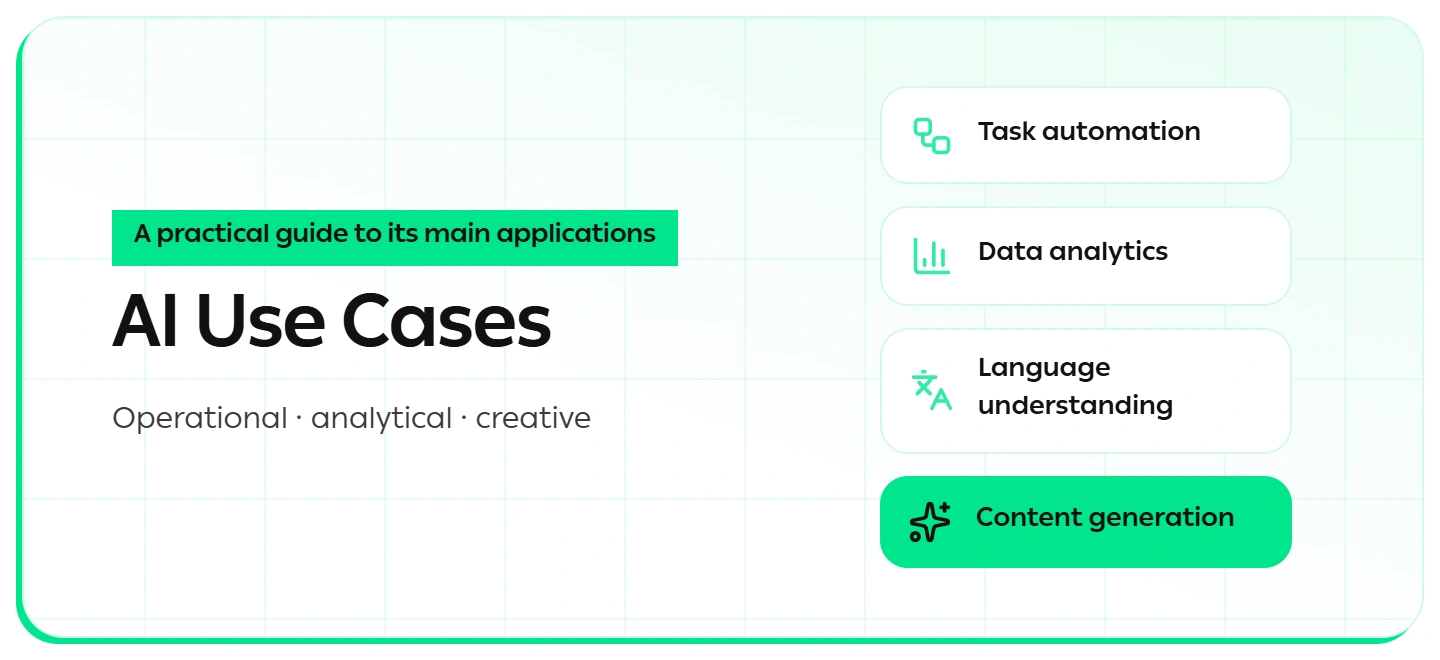
At their core, AI systems learn from data, which means the quality of their output depends heavily on the quality of their input. Their applications can be grouped into three broad categories:
- Operational uses: automating routine work such as data entry and standard customer responses.
- Analytical uses: processing data, identifying patterns, and forecasting future outcomes.
- Creative uses: generating text, images, and marketing content from written instructions.
Uses of AI Across Different Industries
.webp)
AI is now used across many industries, but the way it is applied depends on the available data and the sensitivity of the decision. In sectors such as healthcare, where errors can have serious consequences, AI should support qualified professionals rather than replace their judgment. Automation can expand further in repetitive, lower-risk processes.
Healthcare
AI can support earlier disease detection and medical-image analysis, as well as help specialists review patient information and identify relevant patterns.
Its applications also extend to appointment scheduling, administrative workflows, and remote patient monitoring. In clinical settings, final diagnosis and treatment decisions should remain with qualified healthcare professionals.
E-Commerce
AI can personalize product recommendations based on customer behavior and patterns among similar shoppers. It can also help forecast seasonal demand so businesses can plan inventory more effectively.
Other uses include dynamic pricing, automated abandoned-cart follow-up, product discovery, and immediate responses to frequent shipping and returns questions.
Financial Services
Financial institutions can use AI to identify unusual transaction patterns, support fraud detection, analyze risk, and automate repetitive document-processing tasks.
AI can also help process routine transactions and compliance workflows. Sensitive financial decisions still require appropriate controls, monitoring, and human oversight.
Uses of AI in Business
.webp)
Within an organization, AI in business can support several functions and help teams spend less time on repetitive work.
- Customer service: answering common questions through AI solutions and chatbots, while transferring complex cases to human agents.
- AI solutions for marketing: analyzing behavior, segmenting audiences, and personalizing campaigns and offers.
- Sales: organizing leads based on buying signals and automating selected follow-up tasks.
- Human resources: supporting résumé screening, interview scheduling, and repetitive administrative workflows.
These applications allow employees to focus more of their time on work that requires judgment, creativity, and human interaction.
Technologies Behind AI Applications
Several core technologies power the most common uses of AI:
- Machine learning: allows systems to learn patterns from data without explicitly programming every possible outcome.
- Deep learning: an advanced form of machine learning based on multilayer neural networks.
- Reinforcement learning: improves decisions through feedback and rewards across repeated interactions.
- Natural language processing (NLP): enables systems to understand, classify, and generate human language.
- Generative AI: creates new text, images, and other content, often using large language models (LLMs).
Across these technologies, two processes appear repeatedly: task automation and data analysis. One reduces manual effort, while the other turns information into insights that can support decision-making.
How to Start Using AI
Getting started with AI does not necessarily require a large technical team or a major budget. What matters most is following the right sequence.
A common mistake is choosing a tool first and then looking for a problem it can solve. A better approach is to start with the problem, choose the appropriate solution, and then measure the result.
Define Your Real Need
Start with a clear and measurable challenge such as slow customer response times or weak data analysis.
Ask practical questions: How many hours does this process consume each month? What does the delay cost the business? How many opportunities are lost because of it?
A measurable problem makes it easier to select the right tool and demonstrate its value later.
Choose the Right Tool
Select a ready-made platform that fits your team size and budget instead of automatically building a solution from scratch.
Evaluate factors such as:
- Arabic and dialect support when relevant.
- Integration with your current systems.
- Clear pricing as usage grows.
- The ability to test the solution with your own workflows or data.
Measure and Improve
Track performance and refine the setup based on actual results rather than impressions.
Choose two or three indicators from the start, such as first-response time, the percentage of cases resolved automatically, or conversion rate. Review them regularly to understand whether the AI solution is genuinely improving performance.
.webp)
Conclusion
The uses of AI are not a single package that businesses adopt once. They are a set of tools and applications selected according to the problem being solved.
Start with one process that costs your team time or money, apply the simplest suitable solution, and measure the difference. A small result that can be demonstrated provides a stronger foundation for expansion than a large AI initiative without clear evidence of value.
FAQs About the Uses of AI
Does AI threaten jobs on my team?
AI often changes the tasks within a role rather than simply eliminating the role itself. Repetitive work can move to automated systems, while employees spend more time on complex cases, customer relationships, judgment, and other responsibilities that require human involvement.
Does AI require huge amounts of data?
Not always. Ready-made AI solutions may already be trained for general tasks and can work with a structured knowledge base containing your products, services, and policies. Custom systems usually require larger and cleaner datasets.
What are the main risks of using AI?
Businesses should pay attention to customer-data privacy, access controls, inaccurate outputs, and excessive reliance on automation in sensitive decisions. Human review and clear escalation rules become more important as the impact of an AI-supported decision increases.
How do I measure ROI from AI?
Compare the cost of the AI solution with measurable outcomes such as employee time saved, lower operating costs, faster customer response, improved retention, or higher conversion. Measure performance over a meaningful period instead of judging the result after only a few days.