Every AI wave over the past seventy years began with a huge promise and ended in disappointment — except the current one. Understanding the history of AI separates what is deployable from what is marketing noise.
What Is the History of AI in Brief?
The history of AI spans from 1943, when the first mathematical model of a neuron was proposed, through the 1956 Dartmouth Conference that formally coined the term, across two funding collapses known as AI winters, to the current surge triggered by Transformer models in 2017.
These cycles are a practical lesson: technology succeeds when it meets sufficient data and compute, not when it is announced. Every winter followed promises that outran the hardware.
The Major Milestones in the Origins of Artificial Intelligence
.webp)
Before computers could execute the idea, its foundation was laid. In 1943 Warren McCulloch and Walter Pitts introduced the first mathematical model of a neuron, on which neural networks were built.
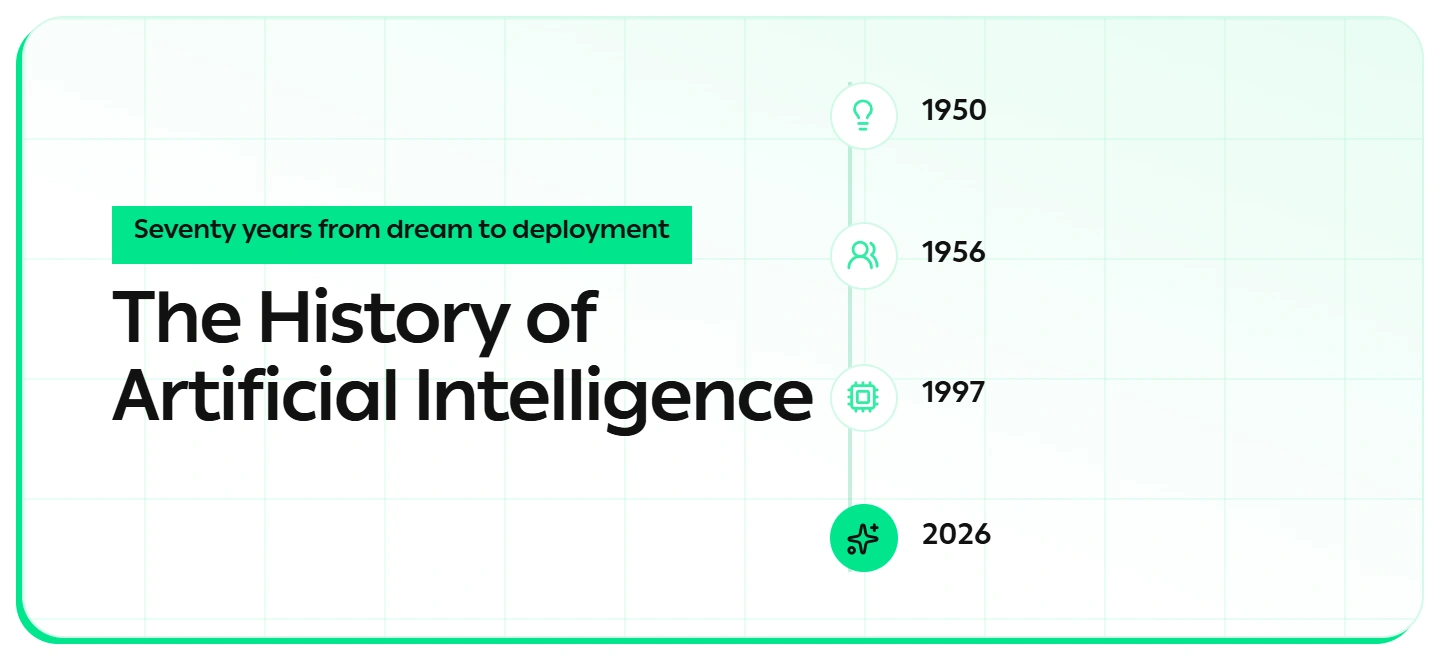
In 1950 Alan Turing published the paper asking whether machines can think. From it came the Turing Test, a benchmark for machine intelligence.
Then came the summer of 1956 at Dartmouth College, where John McCarthy and Marvin Minsky coined the term “artificial intelligence” — the field’s birthdate.
The First Boom and the Winter That Followed (1956 – 1980)
The 1960s saw enormous optimism and funding in the most formative stretch of the origins of artificial intelligence. ELIZA appeared in 1966, simulating a psychotherapist by rephrasing the user’s words as a question, yet many believed they were talking to a person.
Promises outran capability for three reasons that repeat in every later wave:
- Computers too slow for the operations required
- Scarce digital data before the internet
- Problems more complex than researchers assumed
By the mid-1970s funding froze in Britain and the US, and the first AI winter began.
Expert Systems and the Second Winter (1980 – 1993)
The wave returned in the 1980s through expert systems: programs mimicking specialist decisions with “if-then” rules. MYCIN diagnosed bacterial infections at accuracy rivaling physicians, and XCON saved DEC tens of millions yearly configuring its systems.
The flaw surfaced quickly: every new rule needed a human expert to write it, and any case outside the rules broke the system entirely. Maintenance costs consumed the returns, and when the LISP machine market collapsed, the second winter arrived.
Data Returns and Deep Learning Rises (1997 – 2016)
The turning point was not a new idea but new conditions: the internet supplied data and graphics processors supplied compute. Three milestones define the period:
- 1997 — IBM’s Deep Blue defeats world chess champion Garry Kasparov
- 2012 — AlexNet cuts the ImageNet error rate from 26% to 15%
- 2016 — AlphaGo beats the world champion at Go, a far more complex game
Here AI shifted from academic research into a commercial product powering search engines and recommendation systems, and funding never froze again.
The Generative Revolution (2017 – Today)
In 2017 Google researchers published “Attention Is All You Need,” introducing the Transformer architecture behind every large language model. Its core idea is weighing each word against all the others instead of reading in sequence.
In the following years, the Transformer architecture evolved rapidly, leading to the development of more powerful large language models capable of understanding context, generating text, and analyzing information. As deep learning techniques advanced and the availability of data and computing power increased, AI evolved from specialized models designed for specific tasks into systems capable of handling a wide range of tasks simultaneously.
The result appeared in models that write, code, and analyze, then reached enterprises as AI chatbot tools understanding dialects and customer service AI solutions cutting response time.
From 2020 through 2026, Generative AI became increasingly widespread, with the emergence of tools capable of generating text, images, audio, and video, as well as analyzing data and writing code. Businesses also began integrating AI into their daily operations, from automating tasks and analyzing customer behavior to forecasting demand and supporting decision-making.
By 2026, AI had evolved beyond chatbots into multimodal systems and AI Agents capable of understanding different types of information and performing multi-step tasks. AI has increasingly become an important part of digital transformation across industries such as banking, healthcare, e-commerce, marketing, transportation, and logistics.
What This History Means for Your Organization
The lesson from seventy years is clear: projects solving a specific problem with available data succeed, while those chasing broad capabilities fail. Sectors apply it today, such as AI solutions for real estate, which focus on qualifying leads rather than automating everything.
The market moves fast enough to force the decision: Grand View Research puts the MENA AI market at $166 billion by 2030.
How to Start in Four Steps
The historical lesson is useless without a plan. This path avoids repeating earlier mistakes:
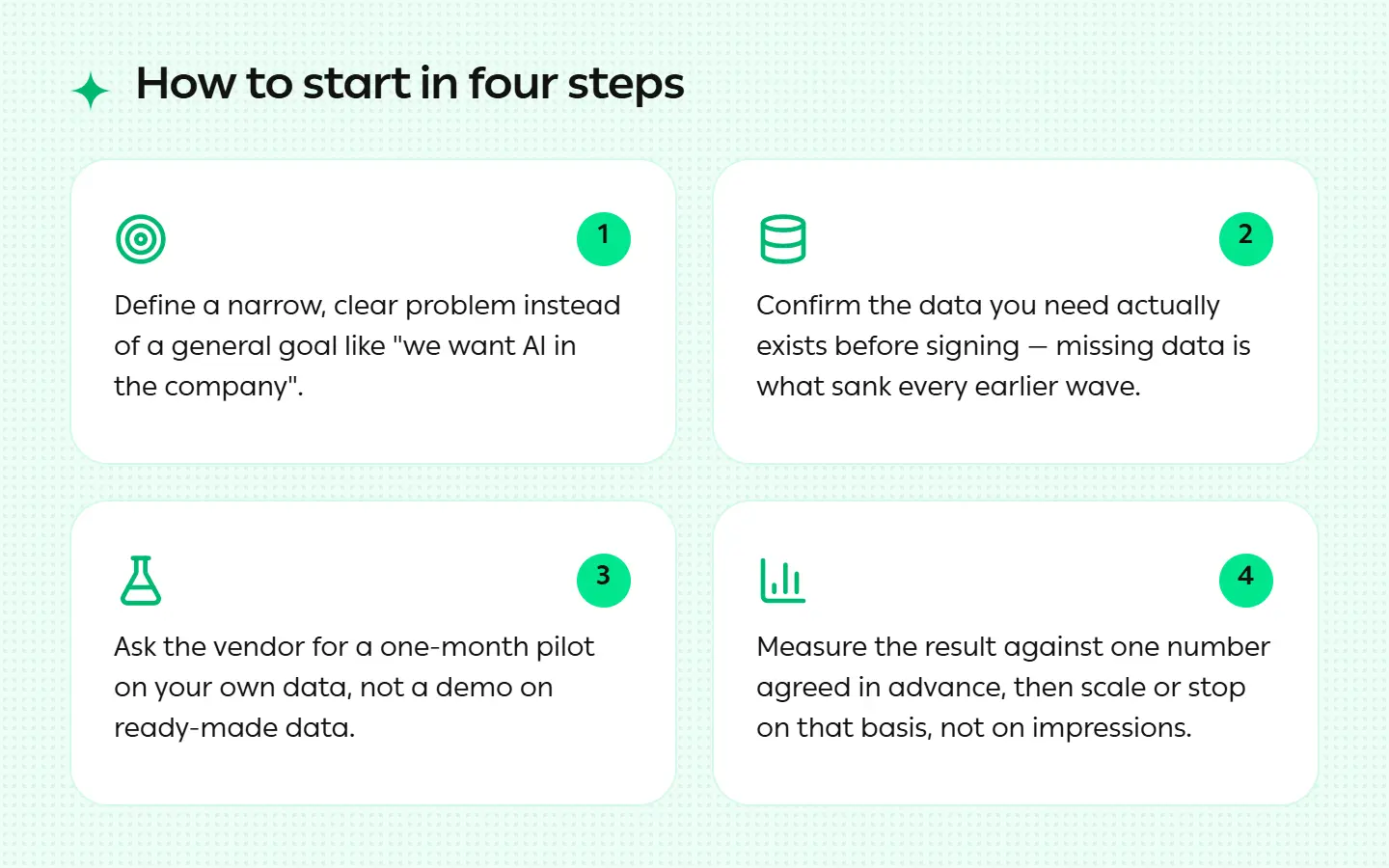
- Define one narrow problem instead of a broad goal like “we want AI in the company”
- Confirm the required data exists before signing, since missing data sank every wave
- Ask the vendor for a one-month pilot on your own data, not a demo on prepared data
- Measure one agreed number, then expand or stop based on it rather than impression
Conclusion
The lesson from the history of AI is direct: earlier waves failed chasing general intelligence before mastering narrow tasks, while the current one succeeded by starting from specific tasks and expanding only after proving value. Start with the same logic at Hulul — one use case, clean data, and a measurable result within a quarter, then expand on what worked.

FAQs About the History of AI
1. What practical lesson does the history of AI offer decision-makers today?
That technology does not succeed on the quality of the idea alone, but on data and compute being available together. Before any contract, ask whether the required data actually exists in-house. A no means the project will repeat the fate of the 1970s and 1980s waves however convincing the pitch.
2. Are we heading into a third AI winter?
The situation differs from before. Earlier waves collapsed because the technology produced no commercial value, whereas today there is real revenue and applications running in production. The current risk resembles a correction in company valuations more than a halt in research and development.
3. Why did image recognition lag for decades while text generation accelerated in a few years?
Because computer vision needed massive hand-labeled datasets that did not exist before ImageNet in 2009. Text, by contrast, was available in enormous volumes online for free, so language model development accelerated as soon as the right architecture appeared.
4. Where does the Arab region sit in this historical trajectory?
The region entered late as a consumer of the technology but is advancing today as an investor and developer through major government initiatives and infrastructure spending. The sharpest challenge remains the scarcity of labeled Arabic data compared with English.
5. How does the expert systems wave differ from today’s in terms of return?
Expert systems required a human specialist to write every rule, so maintenance costs consumed the return within a few years. Current models learn from data directly and improve with use, so the cost of scaling falls instead of rising.