Your company runs an app that recommends products or a bot that answers customers, but what happens behind the screen? Understanding how AI works separates buying tools you don’t understand from deploying technology that delivers results.
How Does AI Work in Simple Terms?
.webp)
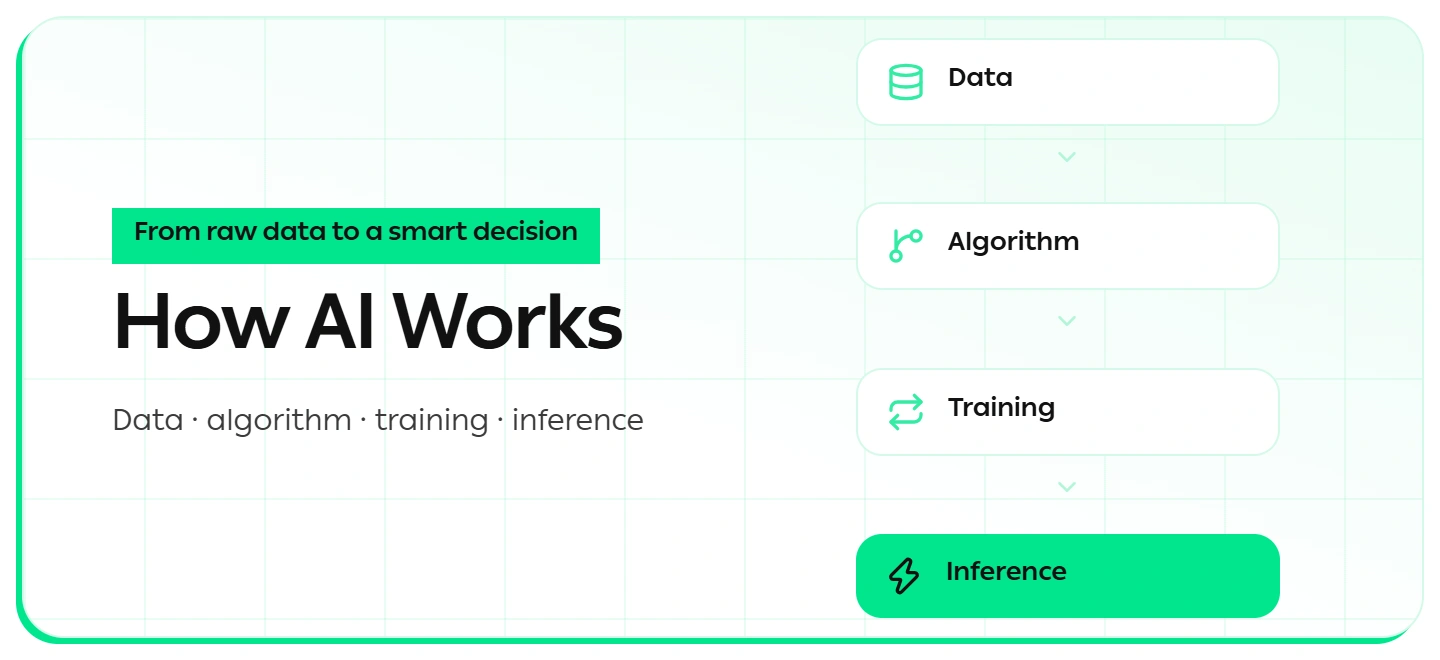
AI works through four sequential stages: collecting data, running it through machine learning algorithms that detect recurring patterns, training the model by adjusting millions of internal parameters, and finally inference, where the trained model applies what it learned to new data it has never seen before.
The core difference is where the rule comes from. Traditionally a developer writes every condition by hand: if a message contains “return,” route it to returns. With machine learning you show thousands of labeled examples and the system derives the rule itself.
The Four Building Blocks of Any AI System
Answering how AI works starts here: every system today, from a search engine to a language model, rests on the same four pillars.
The order is not arbitrary. Each pillar builds on the one before it, and a weak link carries its damage downstream into every stage that follows. An organization with the best algorithm on the market and messy data gets worse results than one with a simple algorithm and clean data.
.webp)
1. Data: The Fuel
There is no AI without training data. The system learns from examples, and the closer they are to your business reality, the sharper the output. A company training on its own conversation logs will outperform a generic model built on open internet data.
Training data quality rests on four criteria:
- Accuracy — free of errors and mislabeled records
- Diversity — covering every customer segment and dialect
- Recency — reflecting current market behavior, not 2019
- Volume — enough examples for each case you want recognized
2. Algorithms: The Rules
The algorithm is the mathematical method used to find relationships inside data, and it sets the ceiling on what the model can learn. Decision trees split data into branches easy to explain, while neural networks capture far more complex ones.
Learning methods split into three, the classification that matters most when picking a vendor:
- Supervised learning — labeled data, best for prediction and classification
- Unsupervised learning — unlabeled data, best for segmentation and anomalies
- Reinforcement learning — trial and error, best for pricing decisions
3. Training: The Learning Phase
The model passes over the data repeatedly, comparing each prediction against the correct answer, measuring the error, then adjusting its weights to shrink it next round. This process, backpropagation, is the core of deep learning.
Duration varies widely. A simple classifier trains in hours on a standard machine, while the large language models behind natural language processing need weeks on specialized servers at a cost in the millions. Most companies therefore fine-tune a pre-trained model instead.
4. Inference: The Decision Moment
Once training is complete the model enters live operation, receiving a new input — a customer question, a scan, a transaction — and returning an output in milliseconds without learning anything new.
The distinction matters financially. Training happens periodically and consumes heavy compute, while inference runs millions of times daily at a fraction of the cost. AI budgets therefore carry two separate line items.

How Does AI Work Inside Real Businesses?
AI reaches an organization through three gateways:
- Automotive AI solutions — flagging maintenance before a breakdown, qualifying buyers
- AI for ecommerce — ranking products per visitor from browsing history
- WhatsApp AI integration — instant replies in the customer’s dialect
- Data Analysis and Decision-Making — Turning operational and customer data into actionable insights by identifying patterns, forecasting demand, and detecting risks and opportunities.
- Internal Process Automation — Using AI to automate repetitive tasks such as document processing, request classification, report summarization, and information extraction from files.
- Intelligent Sales and Marketing — Analyzing customer behavior to identify prospects who are most likely to make a purchase, while personalizing messages, offers, and timing for each customer segment and predicting the likelihood of conversion.
- Customer Service and Technical Support — Automatically analyzing and categorizing customer inquiries, providing instant solutions to simple issues, and routing complex cases to the appropriate department or human employee.
According to Stanford’s 2026 AI Index Report, 88% of enterprises use AI, yet gains concentrate in the few that redesigned workflows.
How to Start in Four Steps
Theory changes nothing without a plan. This path works for any organization:
- Pick one expensive, repetitive task — shipping inquiries eating a third of your support day
- Gather six months of data for that task and clean out duplicates and mislabeled records
- Run the model on 20% of cases for a month under human supervision, logging escalations
- Compare the numbers before and after, then expand or retrain based on the data
Conclusion
How AI works has a simpler answer than it appears: good data, the right algorithm, disciplined training, then operation with a review every three to six months. The gap between an organization that succeeds and one that stalls is not the model or the budget, but data quality and clarity of purpose. Start with one measurable use case with Hulul company before scaling.
.webp)
FAQs About How AI Works
1. How does AI work with Arabic dialects specifically?
Global models are trained mostly on Modern Standard Arabic, so they stumble on phrasings customers actually use. Arabic-first solutions are trained on Egyptian, Gulf, Levantine, and Moroccan dialects, which lifts intent-recognition accuracy noticeably in a real customer service environment.
2. Who owns the data the model trains on?
In enterprise deployments your data stays yours, and the contract should say so explicitly. Before signing, ask the vendor three things: where data is stored geographically, whether it is used to train other customers’ models, and how it is fully deleted when the contract ends.
3. Can the model run inside our own servers?
Yes. Government and banking entities often choose on-premise or hybrid deployment to comply with data sovereignty regulations. The cost is higher and it requires dedicated infrastructure, but it is the only acceptable option in heavily regulated sectors.
4. Which metrics measure success after launch?
Three practical ones: the share of inquiries closed automatically without human involvement, average response time before versus after, and cost per transaction. Compare them directly against pre-deployment figures, otherwise you will never know whether the project returned anything.
5. What happens if the system gives a customer a wrong answer?
Enterprise systems are built with confidence thresholds: if the model’s confidence drops below a set level, it hands the conversation to a human instead of guessing. Review the escalation log monthly, as it is the fastest source for spotting gaps and retraining the model on them.