What Are the Main Types of AI?
The main types of AI are commonly explained through two frameworks: capability and function. Capability describes how broad a system's intelligence is, while function explains how it processes information, uses memory, and responds to new inputs.
Three criteria help distinguish one system from another:
- Scope: does it specialize in one task or operate across multiple domains?
- Memory: does it use previous information to influence new outputs?
- Adaptability: can it adjust its behavior when it receives new data?
These classifications are useful frameworks rather than rigid boundaries, since individual AI applications may combine several technologies and characteristics.
Types of AI by Capability
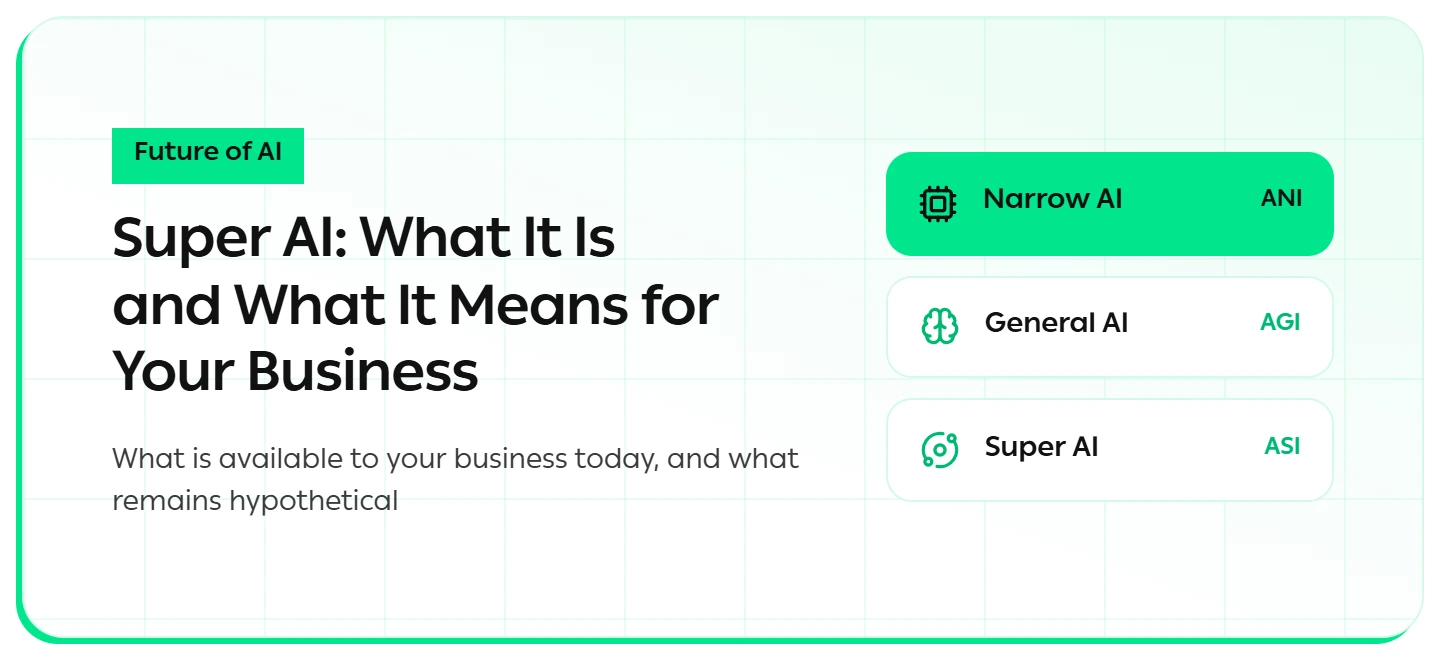
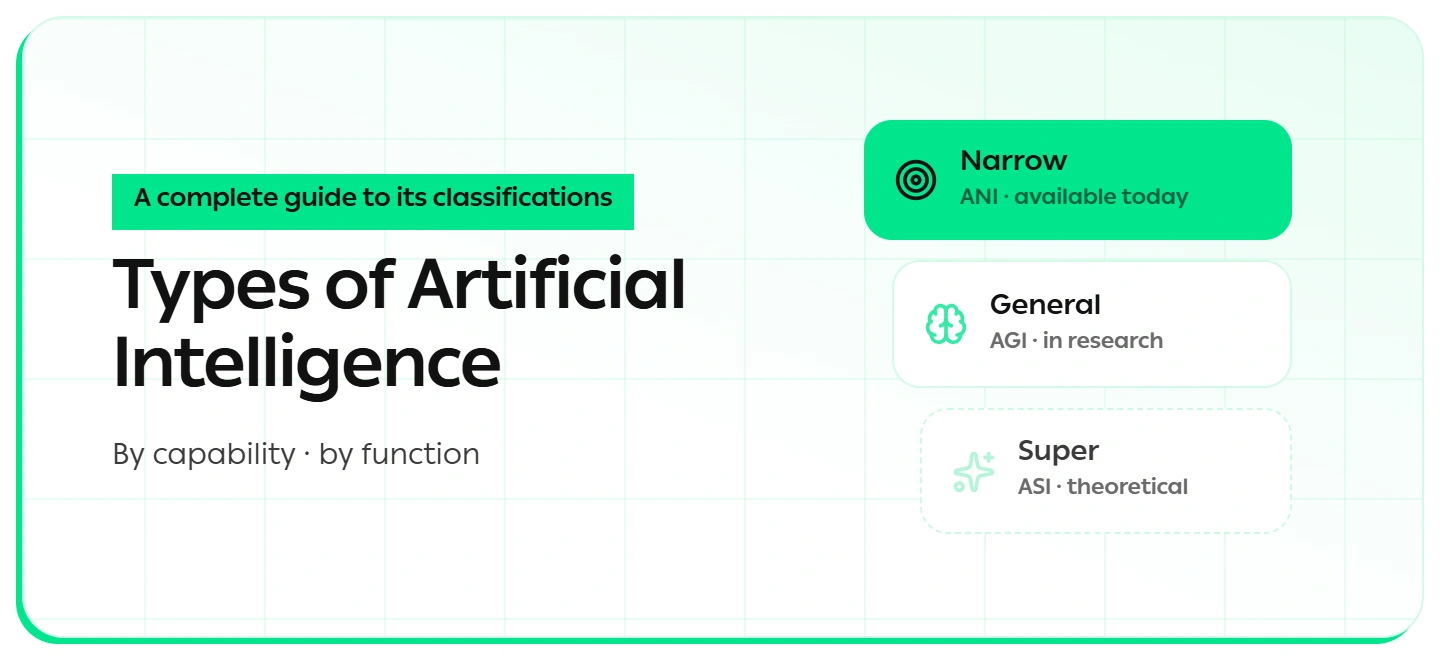
When classified by capability, artificial intelligence is generally divided into three levels: Artificial Narrow Intelligence, Artificial General Intelligence, and Artificial Superintelligence.
.webp)
Artificial Narrow Intelligence (ANI)
Artificial Narrow Intelligence, or ANI, is designed to perform a specific task or group of related tasks.
Examples include:
- Recommendation systems.
- Fraud-detection tools.
- Search engines.
- Customer-service chatbots.
- Generative AI applications.
ANI represents the practical AI businesses use today. Even advanced generative systems remain specialized rather than demonstrating unrestricted human-level intelligence.
For organizations, narrow AI can support customer service, marketing, data analysis, forecasting, and process automation.
Artificial General Intelligence (AGI)
Artificial General Intelligence, or AGI, describes a theoretical system capable of performing intellectual tasks across different domains at a level comparable to human intelligence.
Unlike narrow AI, an AGI system would theoretically transfer knowledge between unrelated tasks without requiring a separate system for each one.
AGI is not an established commercial capability today, so organizations should base current technology strategies on solutions that can solve measurable problems now.
Artificial Superintelligence (ASI)
Artificial Superintelligence, or ASI, describes a hypothetical system that would exceed human intelligence across a broad range of cognitive tasks.
ASI mainly appears in long-term discussions around AI development, governance, and safety. It is not a practical category for choosing current business software.
Types of AI by Function
The types of AI can also be classified according to how systems process information and use previous experience.
.webp)
- Reactive machines respond only to current inputs without relying on stored experience.
- Limited memory AI uses historical or recent data when generating outputs or making predictions.
- Theory of mind AI describes a theoretical ability to understand human beliefs, intentions, and emotional states more deeply.
- Self-aware AI is a hypothetical concept involving systems with awareness of their own internal state.
Most current business applications fall within reactive or limited-memory systems. Theory of mind and self-aware AI remain conceptual categories rather than commercially available capabilities.
Core Technologies Behind AI
AI classifications should not be confused with the technologies that power individual applications.
Common technologies include:
- Machine learning for discovering patterns and making predictions from data.
- Deep learning for complex language, image, and speech tasks using multilayer neural networks.
- Natural language processing for understanding and generating human language.
- Computer vision for interpreting images and video.
- Generative AI for producing new text, images, audio, and other content.
A single narrow AI application may combine several of these technologies.
Business Applications of Different Types of AI
For most businesses, the important question is not which category sounds most advanced. It is which system can solve a specific operational problem.
Customer Service
A chatbot builder can answer common questions, collect customer information, route requests, and transfer complex conversations to employees while preserving context.
This allows teams to automate repetitive service work while keeping human involvement available when judgment is needed.
Marketing and Sales
AI can help teams analyze customer behavior, segment audiences, personalize communication, and automate follow-up.
An omnichannel platform can also bring customer conversations together across multiple channels, giving teams a more consistent view of each interaction.

Data and Analytics
AI systems can process large datasets and identify patterns that may be difficult to find manually.
Hulul company’s data analysis tools can help teams organize customer information, understand conversations, and use data to support clearer business decisions.
How to Choose the Right AI Solution
Start with the business problem rather than choosing the most advanced-sounding type of AI.
Evaluate:
- The task you need to improve or automate.
- The quality of the available data.
- Integration with existing business systems.
- Accuracy and reliability requirements.
- Human-review and escalation needs.
- Security and privacy requirements.
For most organizations, a focused narrow AI solution that solves one measurable problem is more valuable than a broad AI initiative without a defined outcome.
Conclusion
The different types of AI provide a useful framework for understanding what artificial intelligence can realistically do. Narrow AI powers today's practical business applications, while AGI and ASI remain theoretical capability levels.
Start with a defined problem, choose the specialized technology that addresses it, measure the results, and expand when the application delivers clear value.
.webp)
FAQs About the Types of AI
1. What are the main types of AI?
The main types of AI by capability are Artificial Narrow Intelligence (ANI), Artificial General Intelligence (AGI), and Artificial Superintelligence (ASI). AI can also be classified by function into reactive machines, limited-memory AI, theory-of-mind AI, and self-aware AI.
2. What type of AI is currently used in business?
Most commercial systems are forms of narrow AI. They are designed for specific applications such as customer service, recommendations, fraud detection, marketing automation, forecasting, and data analysis.
3. Is generative AI one of the main types of AI?
Generative AI is better understood as a category of AI technology rather than a separate capability level. It creates new content such as text, images, or audio while still operating within specialized narrow AI systems.
4. What is the difference between ANI, AGI, and ASI?
ANI performs specialized tasks and is available today. AGI describes theoretical human-level intelligence that could operate across different domains, while ASI describes a hypothetical intelligence that would exceed human abilities across a broad range of tasks.
5. How should a business choose between different types of AI?
Businesses should start with a measurable problem and choose the narrowest system capable of solving it. Data quality, integrations, reliability, security, cost, and the need for human oversight should guide the final decision.