Every week brings a new model and a headline promising a revolution, and every business owner asks the same question: what does this change for me? The future of AI shows up in the shifts already reshaping customer service, sales and daily operations. This guide ranks six of them and tells you what to do about each one now.
What Is the Future of AI and How Will It Affect Business?

The future of AI is the move from tools that answer a question to systems that complete entire tasks inside a business, powered by machine learning and natural language processing. Small and mid-sized companies gain the most, because costs keep falling while capability keeps growing.
The economics explain the speed. A PwC study on AI's impact in the Middle East estimated AI could add US320 billion to the region's economy by2030,with more than US 135 billion in Saudi Arabia alone. It is an estimate, but it shows where investment is heading.
AI predictions point the same way: adoption is spreading to small businesses as running costs fall. The question is no longer whether to use the technology, but when.
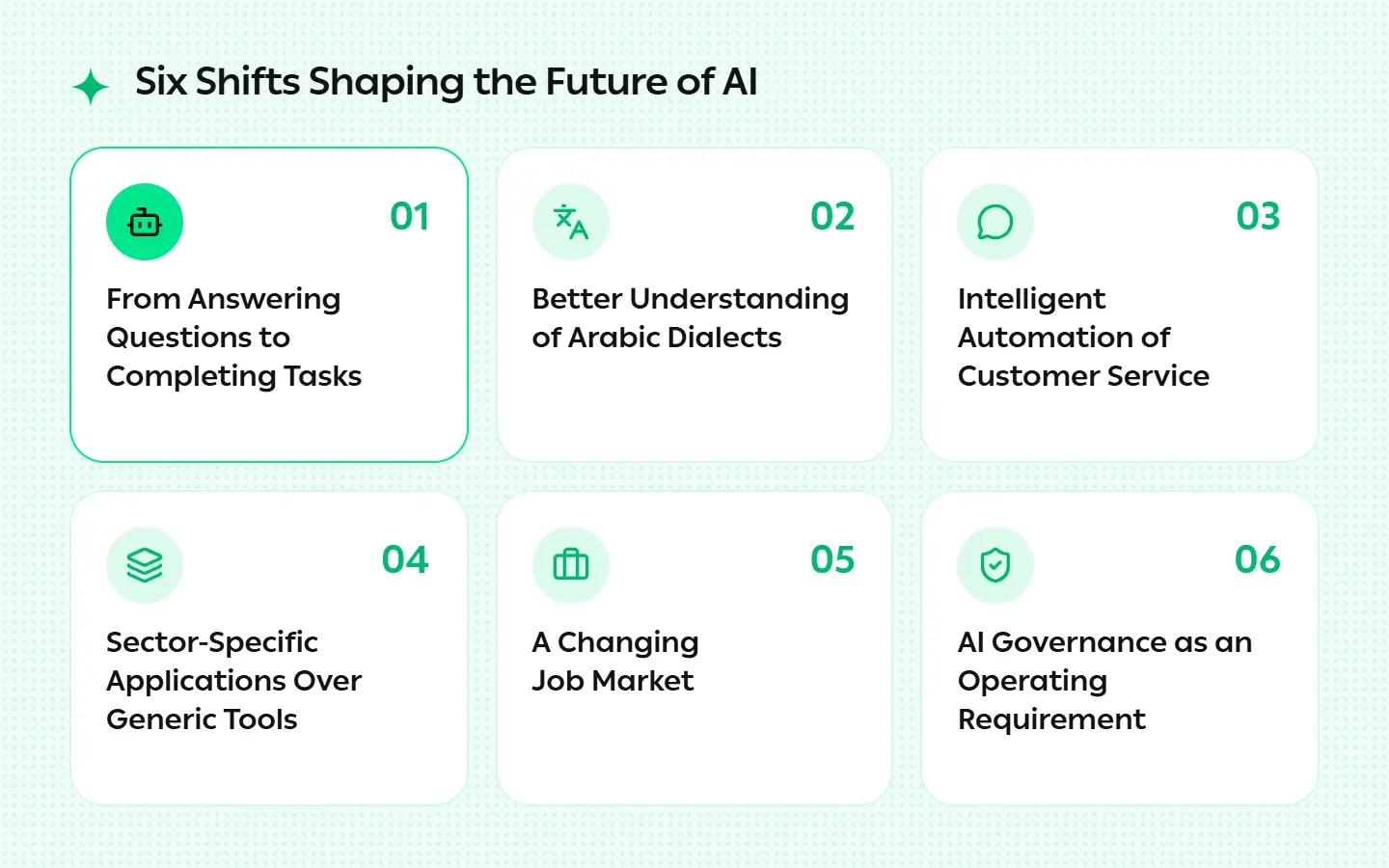
Six Shifts Shaping the Future of AI
The six shifts below run from closest to furthest. Each removes manual steps between a request and its completion, so operations are where the future of artificial intelligence shows up first.
1. From Answering Questions to Completing Tasks
Today's large language models write the reply. AI agents go further and run a chain of steps: they take the order, check stock and issue the payment link inside the same conversation. The shift is from a tool that helps an employee to a system that finishes the job.
2. Better Understanding of Arabic Dialects
Customers write the way they speak, and models trained only on Modern Standard Arabic stumble on the first message. The next wave is models trained on local dialects, which is what makes generative AI fit for real customer service.
3. Intelligent Automation of Customer Service
Repeat questions about prices, bookings and shipping will close automatically at a higher rate, freeing the team for complex cases. Intelligent automation differs from old auto-replies because it understands what the customer means instead of hunting for a keyword.
4. Sector-Specific Applications Over Generic Tools
Generic models are giving way to applications trained for one industry. You can see this in our articles on the future of ai in education and the future of ai in medicine, where adoption starts from one operational task and then expands.
5. A Changing Job Market
The effect observed so far is a change in the mix of tasks within a role more than the loss of the role itself. AI in the future is a partner for repetitive work, not a replacement for judgment or customer relationships.
6. AI Governance as an Operating Requirement
As usage grows, rules become part of daily operations: what the system may complete on its own, what needs human approval, and where customer data is stored. AI governance here is not a legal binder, but a clear list every employee knows.
What Should You Do Today?
These practical steps prepare your business for what is coming:
- Pick one repetitive task that eats your team's time every day.
- Gather your most frequent questions into one organized knowledge base.
- Switch on automation in the channel your customers already use.
- Measure response time and the share of inquiries closed automatically after one month.
To understand the basics, read about the importance of ai, then explore the uses of ai to pick the application closest to your needs.
How Do You Avoid Rushed Decisions?
The most common mistake is buying a tool because it is popular, not because it solves a defined problem. Ask first what task it performs and how you will measure success.
The second mistake is full automation from day one. Start with a flow that routes complex cases to a human agent, then widen the scope as accuracy is proven. That keeps your digital transformation under control.
Conclusion
The future of AI will not arrive all at once. It comes in small shifts the customer notices first: a faster reply and an order completed inside the chat. A business that starts today with one task and measures the result is ready for every shift that follows. Hulul is trusted by more than 40,000 brands and institutions across the Middle East.
FAQs About the Future of AI
What is the future of AI for businesses in the coming years?
The future of AI for businesses points to systems that complete tasks rather than only answering them: agents that take an order and finish it inside the conversation, models that understand local dialects, and broader automation of customer service. Small and mid-sized companies benefit most because costs are falling faster than ever before.
What are the main AI predictions for small businesses?
The main AI predictions for small businesses are that automation becomes available as a simple monthly subscription instead of a costly technical project. Stores, clinics and offices will run instant replies around the clock and connect them to booking and payment, without hiring a developer or building their own infrastructure.
Will AI in the future replace customer service jobs?
AI in the future will change the nature of customer service work more than it removes it. Repetitive questions move to the system, while agents focus on complex complaints and high-value customers. Teams that learn to manage the tools and review their output become more productive, not necessarily smaller.
How much does it cost to prepare for the future of artificial intelligence, and when will I see results?
Preparing for the future of artificial intelligence costs less than most expect: price follows your plan, the number of channels and monthly message volume, not company size. Switching on automated replies in one channel takes days, and the first metrics you can track are first response time and the share of inquiries closed automatically after the first month.
How do I start preparing my business for what is coming?
Start with one repetitive task, such as answering pricing questions or confirming bookings, switch it on in the channel your customers use most, then expand automation gradually once you have measured the result. You can try the platform free for 14 days with no credit card.